« February 2012 »
S M T W T F S
1 2 3 4
5 6 7 8 9 10 11
12 13 14 15 16 17 18
19 20 21 22 23 24 25
26 27 28 29
You are not logged in. Log in
Madhava Turumella's blog
Wednesday, 29 June 2011
I am a lover of my own liberty and so I would do nothing to restrict yours.
Mood:  bright
Topic: Wisdom

My Favourite Picture 


"I’m a lover of my own liberty, and so I would do nothing to restrict yours. I simply want to please my own conscience, which is God." - Mahatma Gandhi  - Young India (21 January 1927)


Posted by madhava at 2:25 PM BST
Updated: Wednesday, 29 June 2011 2:29 PM BST
Sunday, 20 March 2011
BUSINESS ETHICS PRESENTATION - HOUSE OF LORDS


1) I am a Trustee of UKTA (http://www.uktas.org.uk/).  I presented on subject "Business Ethics" in the House of Lords.  This business meeting was chaired by Lord Billimoria, CBE, DL.  


Seated on my right hand side:

1) Mr. RajaSekhar, Minister Political, Indian High Commission, London, UK

2) Mr. Prabhakar Kaza, a well known banker and President of UKTA

3) Lord Billimoria, CBE DL (Founder Chairman of Cobra Beer) http://en.wikipedia.org/wiki/Karan_Bilimoria,_Baron_Bilimoria


2) Me discussing with Lord Billimoria after my presentation.  You can also see Mr. Dan Byles, MP (Conservative Party) and  also Mr. Dalip Puri, Head ( Multicultural Banking) and Head of Global Indian Proposition, HSBC Bank plc. 


Posted by madhava at 1:15 PM BST
Wednesday, 19 January 2011
UKTA SANKRANTI CELEBRATIONS

http://www.thehindu.com/news/international/article1099429.ece?sms_ss=facebook&at_xt=4d36d21edbf1aa68,0


U.K. celebrates Sankranthi

The United Kingdom has celebrated its first ever Sankranthi, the festival of harvest, in the House of Commons.

Tory MP for North Warwickshire and Bedworth, Dan Byles and Minister (Political) Indian High Commission C. Rajasekhar were the chief guests of the function organised by U.K. Telugu Association.

Speaking on the occasion Dan Byles, introduced himself to the audience as the son-in-law of Andhra Pradesh, having married a Telugu lady, said that the hospitality of the Telugu people is unforgettable and promised full support to the community.

“As the bilateral relations between India and the UK are strengthening up, events like this help to further strengthen the fusion,” said Mr. Rajasekhar.

He also praised Prabhakar Kaza, President of UKTA and his team for organising such an event in a novel style and with a touch of class.

“We hope to bring the Telugu culture to life in this country and introduce our customs and traditions to the English citizens too. Telugu New Year is the right opportunity and would be well received,” said Kaza.

Madhava Turumella, Trustee, UKTA explained to the audience the significance of Sankranthi and it’s association with the people of Andhra Pradesh.

Around 150 people attended the programme.

Dr John Marr, eminent Tamil Scholar and Carnatic music practitioner who was conferred Padmasri award, kicked off the cultural side of the evening with a song penned by Syama Sastry and it stood as the highlight of the evening.

The members of TPUK and students of London’s Bharatiya Vidya Bhavan entertained the audience with their dance performances in Kuchipudi, Bharatanatyam and Kathak.

Keywords: U.K. Telugu Associationcultural eventNRIs 


Posted by madhava at 3:50 PM GMT
Thursday, 18 November 2010
Art of Forgiving
Topic: Wisdom
All of us have been wronged by someone or the other. As we carry on with those grudges, we not only allow the other person to hurt us, but also let him control our life each moment. Revenge and turmoil eat our soul and engulf our life.

The most creative power given to human beings is the power to heal the wounds of the past, the power to forgive.

Forgiveness is a gift that God has given us for healing ourselves. It aligns us with the cosmic scheme through which we learn to accept the occurrence of events in our lives. Forgiving is the essence of spirituality because it liberates us from our suffering.

Guru Granth Sahib, the holy book of Sikhism, is full of verses that emphasise the need to forgive. “Bure da bhala mana gussa man na vasa” (Be grateful to the one who is bad to you since he is only an instrument. Don’t allow anger to fester in your mind), goes one verse.

We think that forgiveness is an excuse for escapism, inaction or cowardice and only those who cannot fight forgive. But there is a difference between fearing and forgiving. It is incorrect to believe that our decision to forgive will turn us into a coward. The Bible says forgiving is a sign of power.

Forgiving does not require us to reunite with the person who broke our rust, nor does it mean we accept the person’s behaviour. It merely means that we erase the “hate” within ourselves and stop living a life of torment and pain. Forgiveness heals the past releasing ill-will against the person while not forgetting the pain that guides our future actions.

The first step to forgiveness is recognising that by holding on to our grudges to make the other person unhappy we are actually making ourselves unhappy.

The truth is that attachment to the hurtful past does not harm the other person, but negatively impacts our emotional well-being . Martin Luthar had said “forgiveness is pure happiness”.

(Source: By Ragini Gulati, Hindustan Times)

Posted by madhava at 11:09 AM GMT
Tuesday, 16 November 2010

http://www.eventbrite.com/event/1001011051/efblike


WM Inter Faith Week - Launch Event

Saturday 20th November 2010


Join us to celebrate the richness of our religious and spiritual diversity


From the 21st - 27th November 2010 the entire West Midlands will celebrate together the richness of religious and spiritual diversity for Inter Faith Week. This monumental occasion will bring together faiths and religions to help build stronger community relations, positive change and understanding.


The week will play host to workshops, seminars, and celebrations that will take place throughout the region. The events will aim to strengthen inter faith relations, increase awareness of the different and distinct faith communities and increase understanding between people of religious and non-religious belief.  To find out about the exciting activities in your area please visit: http://www.wmfaithsforum.org.ukor http://www.interfaithweek.org/


Come and help us celebrate the launch of the West Midlands Inter Faith Week. This energetic celebration will be bursting with live performances, exhibitions, stalls and food! please find details below:


Inter Faith Week Regional Launch

Date:  Saturday 20th November 2010

Time: 5pm -8.30pm (Exhibition, networking and vegetarian buffet at 5pm. Main event to start at 6pm)

Location: Coventry Central Methodist Hall, Warwick Lane Coventry, West Midlands CV1 2HA

Guest Speaker:  Madhava Turumella - Inter-Faith Committee of the Hindu Forum of Britain


For more information on Inter Faith Week contact Selina Brown or Gareth Jones on 0121678 88 40 


Posted by madhava at 11:22 AM GMT
Monday, 15 November 2010

Have you got a real faith? or is it merely a political aspiration? is it merely a larger kind of selfishness? or is it merely that you wish to be free to oppress others, as you are being oppressed?  Do you hold your political creed from a higher source?  Is it God that is born in you?  Have you realised that you are merely the instruments of God, that your bodies are not your own?  You are merely instruments of God for the work of the Almighty.  

-- Sri Aurobindo

Articles from Bande Mataram 


Posted by madhava at 1:48 PM GMT
Sunday, 14 November 2010
Releasing the Reins – Changing Others

Releasing the Reins – Changing Others

(When we feel the need to change others, take the time to look inside yourself, find the mirror and the message)


Our perception of humanity as a whole is to a large extent, dualistic. We paint people with a broad brush – some are like us, sharing our opinions and our attitudes, while others are different. Our commitment to values, we have chosen to embrace, is often so strong that we are easily convinced that our way is the right way. We may find ourselves frustrated by those who view the world from an alternate vantage point and make use of unusual strategies when coping with life’s challenges. However, ardently we believe that these people would be happier and more satisfied following our lead, we should resist the temptation to try to change them. Every human being has been blessed with a unique nature that cannot be altered by outside forces. We are who we are at any one point in our lives for a reason, and no one person can say for certain what another should be like.


The reasons we try to change one another are numerous. Since we have leaned over time to flourish in the richness of lives we have built, we may come to believe that we are qualified to speak on behalf of the greater source. The sum total of our knowledge will never compare to what we do not know, however, and our understanding of others’ lives will forever be limited. The potential we see in the people who are a part of our lives will never be precisely the same as our own, so we do these individuals a disservice when we make assumptions about their intentions, preferences, and goals. Our power lies in our ability to accept others for all their quirks and differences and let go of the need to control every element of our existence. We can love people for who they are, embracing their uniqueness, or we can love them as human beings from afar. Your ability to influence people may grow more sophisticated because others sense that you respect their right to be themselves, but you will likely spend more time gazing inward, into the one person you can change yourself.


(Dilip Dhingra, Ideas Exchange, October, 2010)


[I think the above writer may have been inspired by the thoughts of Sri Bala Gandagar Tilak especially his commentary on Bhagawad Gita - Karma Yoga] 


Posted by madhava at 8:26 AM GMT
Friday, 12 November 2010


Posted by madhava at 10:16 AM GMT


Posted by madhava at 10:15 AM GMT


Posted by madhava at 10:13 AM GMT
Tuesday, 9 November 2010
Hyprocrisy
Hypocrisy is the homage that vice pays to virtue...

Posted by madhava at 3:42 PM GMT
Monday, 25 October 2010
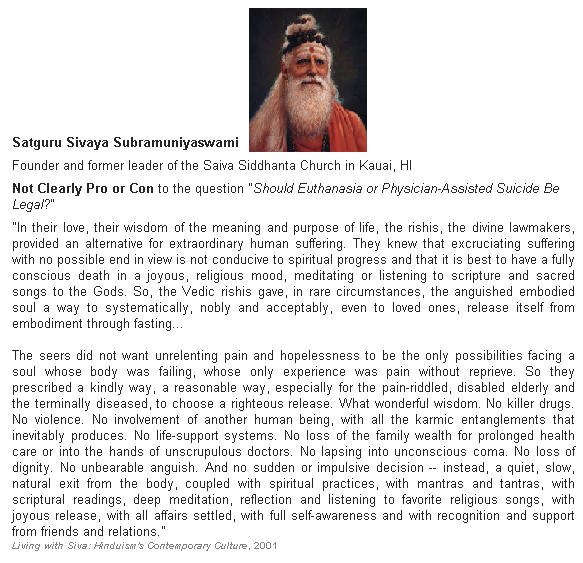
Hinduism and Organ donation
Topic: As I think

It is very alarming to know some of the Hindu scholars are taking an opposite opinion and ruling that Hindu scriptures do not give permission to organ donation.  

I sincerely believe Veda does sanction Organ Donation:

We need to take Veda as a whole and look at it from a Helicopter view then the landscape becomes clear.  Veda speaks of both  "Para" and "Apara".  Antyesthi (funeral) is an apara samskara.   

In Veda Death (apara karma) is spoken in 10th Mandala, but health is spoken in 7th Mandala. So before we talk about Death let us talk about Health first.  

An overwhelming desire is expressed here in the Vedic prayer  "Deliver me from death, not from immortality" (RigVeda 7.59.12)  

Seers also express their view why they have taken birth.  "why they have taken birth" they say that they entered the path of Gods.  à¤† देवानामपि पनॠथामगनॠम यचॠछकॠनवाम तदनॠपॠरवोळॠम | अगॠनिरॠविदॠवान स यजात सेदॠहोता सो अधॠवरांस रतून कलॠपयाति ||   “We have also entered the path of the gods to prolong our lives as long as we are capable." [10.2.3]  


In RigVeda Seers invoke health related matters; where they invoke the stories of cures.  Please refer  Rigveda 7 Cantos 68, 69, 70,71,72 where Asvini Devatas (The Hindu Vedic Gods responsible for health) are praised.  Here the the word "Deva" is very important to understand to gain the spirit of Veda. 

In the Nirukta, Yaskacharya has defined the word 'deva' as follows:     'A deva is one who gives gifts (devo danat), who is effulgent (devo dipanat), who illumines (devo dyotanat), and who resides in heaven or the celestial world (dyusthane bhavatiiti).' (3) [Nirukta, 7.15.1]

As per Rigveda this earth [mortal's body] is Asvini Devata's  possession [7.70.1].  They are sought in every home.   The Vedic Seers glorified Asvins as friends of Indra, Mitra, Varuna and Aryamans.  Indra is praised in 2nd Mandala as a God who has “the power to still what moves and set in motion what is still”  

I am sure you are familiar with Chayan Prasa (Ayruvedic health supplement) it has its origins in Rigveda.  "That gift, which all may gain, you gave to CyavÄ na, when he grew old, who offered you oblations, then you bestowed on him enduring health." [7.68.6]  (Cyavana Prasa) 

Because this earth is their possession, mortals can not claim or hold their magic from them.  From veda it is understood Body organs [responsible for vitality] are their possessions.  All humans would like to be healthy.  We understand that we maintain our health with the possessions of Asvins.  So one must not detain them and their possessions.  So it is advised to donate when you have been asked.   "O Asvins men call on you with hymns in many places, but let not other worshippers detain you." [7.69.6] 


The following verse from Rigveda, in my humble opinion, gives exclusive permission to organ donation:

"Oh Asvins you freed CyavÄ na from old age and weakness: you brought the courser fleet of food to Pedu. You rescued Atri from distress and darkness. You removed the JÄ huá¹£a the bonds that bound him." [7.71.5] - Atri lost his eyes and then other eyes were given to him. It is said Jahusa had a kidney failure. 

The story in Bhagawat says Indra and other gods went to Dadhici. And Dadhici donated his organ. This famous story took its inspiration from the above edic verse. So as you have taken the gift so give the gift. One must not detain the Ashivini Devatas they should release them like Maharshi Dadhici did [ story inspired from Rik 7.69.6]


As per Veda Ashivns have gifted our health.  And what must be our attitude towards those Asvini Devatas?  Sri Krishnaji in Gita gives guidance here:The Gods, being ple ased by sacrifices, will also please you; thus nourishing one another, gain general prosperity for all.  [Gita 3.11] -- we must understand that we must give gifts back.

A number of legends are found illustrating the power of the Asvins in healing the sick and assisting those in trouble, from which we learn that they could restore youth and vigour to the aged and decrepit; they rescued a man from drowning, and carried him in safety to his home. The leg of VispalÄ , that was cut off in battle, they replaced by another one [first known transplant in veda]. At the request of a wolf, they restored sight to a man who had been blinded by his father as a punishment for slaughtering a hundred and one sheep, which he gave to the wolf to eat. They restored sight and power to walk to one who was blind and lame. As a result of these and other similar legends,


Also it is important to read the story of Body donation from Srimad Bhagawat:

"O King Pariksit, following the Lord's instructions, the demigods approached Dadhici, the son of Atharva. He was very liberal, and whenthey begged him to give them his body, he at once partially agreed. However, just to hear religious instructions from them, he smiled and jokingly spoke as follows." [Bhagawat 6.10.2]

In this material world, every living entity is very much addicted to his material body. Struggling to keep his body forever, everyone tries to protect it by all means, even at the sacrifice of all his possessions. Therefore, who would be prepared to deliver his body to anyone, even if it were demanded by Lord Visnu? [Bhagawat 6.10.4]

The Gods replied: O exalted brahmana, pious persons like you, whose activities are praiseworthy, are very kind and affectionate to people in general. What can't such pious souls give for the benefit of others? They can give everything, including their bodies. Those who are too self-interested beg something from others, not knowing of others' pain. But if the beggar knew the difficulty of the giver, he would not ask for anything. Similarly, he who is able to give charity does not know the beggar's difficulty, for otherwise he would not refuse to give the beggar anything he might want as charity. [Bhgawat 6.10.4-5]

The great sage Dadhici said: Just to hear from you about religious principles, I refused to offer my body at your request. Now, although my body is extremely dear to me, I must give it up for your better purposes since I know that it will leave me today or tomorrow.[Bhgawat 6.10.7] 

Also we know that Lord Siva performed Organ Transplant by giving an elephant head to Lord Ganesha!

So one can conclude from above vedic verses, Bhgawad Gita and and the guidance story from  SrimadBhagawat, Sivapuran that Organ Donation is allowed and exclusively sanctioned in Veda.

Everybody undergoes death, and bodies can have imperfections.   People lose their limbs while they are alive.  Some lose their hands, some lose their legs and some lose their eyesight which is not uncommon.  This is called “Imperfection” in body.  So what would be the story of a body (pardhiva sarira) that has imperfection?!)  or about a body that has donated the organs.  

The following verse gives sanction to cremation of bodies with such imperfections:

“Go forth, go forth on those ancient paths on which our ancient fathers passed beyond... Unite with the fathers, with Yama [king of the dead], with the rewards of your sacrifices and good deeds, in the highest heaven. Leaving behind all imperfections, go back home again; merge with a glorious body” (Rig Veda 10.14.7-8)

Imagine during Maharshi Dadhici’s cremation and the above verse.  You can get the picture of imperfection.  I am not commenting on the rest of the verses quoted in 10th Mandala because they all talk about cremation to a body which has no bearing on ORGAN DONATION.  Rigveda 10th Mandala speaks of purifying the body in order to hand it back to the gods but it doesn't speak of having a full body.... who are we to determine what is a full body or not when Body is not really ours but a mere gift from them!  

The verse from Easavasya is very apt here:वायॠरनिलं अमॄतमॠअधॆदं भसॠमांतं शरीरं । ऒं कॠरतॊसॠमर कॄतं सॠमर ।  "Let this temporary body be burnt to ashes, and let the air of life be merged with the totality of air. Om Oh my mind remember --- all that is done remember" [Easavasya Upanishad 17]

Donating Organ is a “Krutam” --- Good Deed.... Om KrutaM Smara... remember you have done a good deed..


ऒमॠअसतॊमा सदॠगमय । तमसॊमा जॠयॊतिरॠगमय । मॄतॠयॊरॠमा अमॄतं गमय ।Om AsatOma sadgamaya, tamasOmA jOtirgamaya, mrityOrmA amRUtam Gamaya.

Love & Light,
Madhava

Posted by madhava at 8:07 PM BST
Friday, 22 October 2010
Live with Honour
Mood:  bright
Alexander had asked a Brahmin as to what they taught which inspired Hindu warriors to such high heroism, the Brahmin had replied in one sentence – “We teach our people to live with honour.”

Posted by madhava at 7:53 AM BST
Tuesday, 19 October 2010
where on earth
Mood:  bright

Xenophon records. “One day Socrates met a young man on the streets of Athens. ‘Where can bread be found?' asked the philosopher. The young man responded politely. ‘And where can wine be found?' asked Socrates. With the same pleasant manner, the young man told Socrates where to get wine. ‘And where can the good and the noble be found?' then asked Socrates. The young man was puzzled and unable to answer. ‘Follow me to the streets and learn,' said the philosopher.

http://en.wikipedia.org/wiki/Socrates 


Posted by madhava at 8:00 AM BST
Keep away from gossip
Mood:  chatty
 “Keep away from the gossip of people. For rumour is an evil thing; by nature she's a light weight to lift up, yes, but heavy to carry and hard to put down again. Rumour never disappears entirely once people have indulged her.” - Hesiod Greek author

Posted by madhava at 7:35 AM BST
Tuesday, 17 August 2010
Yoga
Recently several Church leaders took objection to practise of Yoga in their 

premises.  I am interviewed by BBC on this subject.  My argument is follows:

Yoga is a comes from a root called "Yuj" which means "Union", "Concentrate once 

attention on".  So with in the context of its root the word Yoga can be any.  

There are 6 types of accepted practises in Yoga.

(1) Hata Yoga (2) Raja Yoga (3) Gnana Yoga


BBC Podcast - a summary in 30 minutes. Please listen from 0:8:00 for the excerpt 

of my interview. Look for podcast of Tue, 17 Aug 2010
http://www.bbc.co.uk/podcasts/series/faith

1) BBC RADIO MERSEYSIDE 
http://www.bbc.co.uk/iplayer/episode/p009942h/Daybreak_with_Wayne_Clarke_15_08_201

0/
Listen From: 0:58:00

2) BBC RADIO LIECESTER
http://www.bbc.co.uk/iplayer/episode/p009934n/John_Florance_15_08_2010/
Listen From: 1:06:10

3) BBC RADIO DERBY
http://www.bbc.co.uk/iplayer/episode/p00992rs/Johnny_Kinch_15_08_2010/
Listen From: 1:18:30

4) BBC RADIO OXFORD
http://www.bbc.co.uk/iplayer/episode/p00993tj/Phil_Mercer_15_08_2010/
Listen From: 1:34:45

5) BBC RADIO TEES 
http://www.bbc.co.uk/iplayer/episode/p00994c5/Mike_Hill_15_08_2010/
Listen From: 1:44:26


6) BBC RADIO SHEFFIELD
http://www.bbc.co.uk/iplayer/episode/p00994qg/Sunday_Breakfast_15_08_2010/
Listen From: 1:50:00


7) BBC RADIO GUERNSEY
http://www.bbc.co.uk/iplayer/episode/p0099460/Andrew_Hislop_15_08_2010/
Listen From: 1:12:30


9) BBC RADIO LANCASHIRE
http://www.bbc.co.uk/iplayer/episode/p00993lj/Joe_Wilson_15_08_2010/
Listen From: 2:24:00

Posted by madhava at 3:00 PM BST
Updated: Wednesday, 20 October 2010 12:50 PM BST
Tuesday, 15 June 2010
Caste Sytem in India - Bhagawan Srikrishna is clearly against caste system
Mood:  chatty
Topic: As I think

When ever I do Q&A regarding Hinduism, I often get asked the question regarding the caste system within Hinduism.  I agree it used to be quite bad.  But Hinduism has nothing to do with Caste system.  Vedas do not talk about Caste as we understand it.

Kula is a word that did not appear in Veda.  Rig Veda only at one place mentions Sudra and Vaisya each and that too at a very late period, though the word Vasa has been frequently used as equivalent to common people of a gana. There is mention of the word Sudra in the Purush Sukta, but it is proved a later day interpolation  [Rigveda10-90-12], because in the entire veda the word "Sudra" appears only once!! 

We do not find any mention of the word Sudra in the Brahmanas but they do mention Kshatriyas and Vaisyas but not the Sudras. {*} It may be concluded that the Sudras might have belonged to either of the two mentioned castes and thus there existed no need to mention them separately.  Rigveda also makes it clear that no section, group or division was considered low in social order. 
 
Manusmiriti also says that,’ One becomes a Brahmin by his deeds, not by his family or birth. even a Chandal is a Brahmin, if he is of pure character.’(Ix-14-48)   Also Rishi Moudgalya in Rigveda is described as a Warrior Seer who wields a sword and rushing to recover cows from thieves  (10.102) Mougdalya can be considered a Kshatriya for his sword wielding action but he is a perfect Brahman.

Can a cart-man be considered a Sudra?  if so then in Chandogya Guru Raikva taught Jansruti even though he was a cart man (Sudra!). The Vedic king Sudas could be a Sudra but was patron king of Visvamitra, the Brahmin saint. [Rigveda, viii, 53. 9-11, and vii, 18.]  If contempt was existing towards Sudras then how could we explain Vasistha and Viswamitra's actions?  Definitely they were not discriminating.

The conclusion is that in Vedic India caste system was not present.  The people were classified as per their varna but that has no bearing on Kula.  Also Sudra is not mentioned in Veda,  however unfortunately the sudras are treated and placed so differently and maliciously today in the Hindu social order.


There are two distinctive words "Kula" and "Varna".  Kula means Caste, Varna means Quality.   In Bhagawad Gita, Holybook of Hindus, Arjuna uses the word "Kula" (Chapter 1 verse 40).  He says that the caste will get disturbed if women belong to a particular caste (as it is used today in India) become corrupt and do unwanted things leading to breaking of the caste system.  For this Lord Krishna's answer was very clear: Kutastvaa Kasmalam Idam = How did this dirty thinking came in to your mind?  Anaryam = This kind of thinking is not noble Asvargyam = This thinking can not offer you heaven Akeertikaram = This thinking is a cause to the infamy.  (Chapter 2 verse 2)  --- Please note that this is the first verse spoken by Lord Krishna.  So it is clear from this verse that Lord Krishna is totally against the word "Kula" which Arjuna has used.  Lord Krishna is very clearly saying that this kind of thinking is not noble.


So it is clear that Holy Gita is against caste system!!!  It is unfortunate that in India those who say they are Hindus are following what is denounced by Lord Krishna.  Even in Vedas you do not see the word "Caste" (Kula).  

When you approach someone you will never ask what is your Varna, but rather what is your caste...


This is where the difference lies! It is the dividing line between varna and caste. Varna is something one needs to contemplate within oneself. It has nothing to do with the Caste one is born in. Internally what one is capable of doing decides what ones Varna is...

Let us take the example of Military --- you have:-


a) Strategists - Thinkers who never fight the war
b) Warriors - Those who shoot to kill and defend the country
c) Economists / CEOs / Defense secretaries - Those who keep calculating which artillery costs how much and where they could do savings for the country by not compromising security.  They do this with out any selfish motive  -- e.g. modern day politicians and defence secretaries
d) Cleaners -- Those who keep the Army vehicle ready for combat; who cook food in the kitchen for the army; who pave the roads for Army; who does the laundry for Army; etc..;

Varna has to be understood in the above context:
(a) Strategists - Brahmins
(b) Warriors - Kshatriyas
(c) Economists - Vaisyas
(d) Cleaners - Sudras

They are classified as per their calibre. Their classification is entirely dependant on their personal likes and dislikes. For example a Strategist can not take up a combatant position because he doesn't like a physical combat.  But he is perfectly capable of preparing a war strategy.

Any modern day organization will have people fit in to this varna system. Now you may ask, where did the discrimination in the name of caste came in to picture?!

If you see around you would see discrimination rampant --- CEOs earn 30 times higher salary than those who do cleaning job. And CEOs often don't come in to contact with cleaners... It is just that their worlds don't match up! They keep to their circles. Isn't that discrimination?! It is in this context where caste system came in to picture.  

In old days people kept to their circles.  It is like attending social clubs.  In order to get entry in to a Bikers club you need to have some connection with bikers.   That is caste....

Hinduism is taking unnecessary bashing for something which they never created.  Hindu Theology can not be responsible for social evil...  


Posted by madhava at 10:59 AM BST
Updated: Monday, 25 October 2010 8:06 PM BST
Saturday, 29 May 2010
Alternative economic models
Mood:  chatty
Topic: As I think
 
I find this site very interesting. I think the concept is worth investing our time :-


Both Capitalism and Communism are economic models based on scarcity, technological advancements generate efficiency which leads to an abundance of goods that is regulated economically by marking up prices around a minimum wage to generate a false sense of scarcity. As robots reach commercial viability and technology reaches a point of super efficiency the only actual scarcity left will be the natural scarcity of land, raw materials, and energy. Under these conditions an alternate economic model could be applied that focuses on preserving these resources and further maximizing our returns. ---


Posted by madhava at 3:07 PM BST
Updated: Saturday, 29 May 2010 3:08 PM BST
East or West Mahatma Gandhi's thoughts are the best
Mood:  chatty

Out of curiosity, I have been extensively reading about various economic models for the last 2 years. I still didn't find any model that comes close to Gandhian Economics which aims at restoring the human dignity. I think this is the way to go for the humanity. Exploitation stops when a human truly recognizes other human himself. Vedas of Hindus say that (know thyself and do not cheat others - Veda). We know great examples on how to restore human dignity. Buddha and Jesus Christ have shown how to restore human dignity by their acts of great compassion --- East or West Mahatma Gandhi's thoughts are the best :-)

 http://www.mkgandhi-sarvodaya.org/articles/trusteeship.htm 


Posted by madhava at 3:04 PM BST
Saturday, 22 May 2010
Dalai Lama condemns capitalism | World | News | Toronto Sun


The Dalai Lama on Thursday declared that he is still a Marxist in spirit who condemns capitalism as a system whose main goal is "how to make profit." 

I have very deep respect for Dalai Lama, he is a fantastic being. However academically speaking, how could he be a Marxist and the leader of Buddhism at the same time?! 

I am hoping he meant the above in a lighter note. Because the whole issue is very deep. Profit can only be made where there is demand. Demand is always exploited by the opportunists. 

In Buddhism, the term karma is used specifically for those actions which spring from the intention (Pali: cetana) of an unenlightened being. Being travels from birth to birth towards enlightenment towards that Buddha state. 

Each being is unique. Just like the waves in the ocean can not have same velocity and length; just like thumb prints of humans do not match with each other; the karma of beings does not match. The soul has a unique code. The soul is as unique as the thumb print of a human body. 

Marxism gives importance to matter over spirit. Matter can be organized; matter can be paraded; matter can be denied. For example, a Marxist aspires to create only one type of car in the entire world with out any variety. By doing so his intention is to deny giving raise to desire and envy. But just like we can't ask all the waves in the ocean to raise at the same length and velocity, we can't put a stop to desire. It is this desire that makes room for profit. 

We are humans and we have our frailties. Marxism is intolerant towards human frailties. Stalin is a great example, recently what happened in Tianmen Square (massacre of students)  is also a great example of Marxist intolerance towards human frailty. Glasnost of Gorbachev which gave raise to democracy in Russia is a fine example of spirit removing itself from the clutches of Marxist control!

Is Dalai Lama denying the importance of enlightenment by declaring he is a marxist?! This need clarification.


Posted by madhava at 12:18 PM BST

Newer | Latest | Older